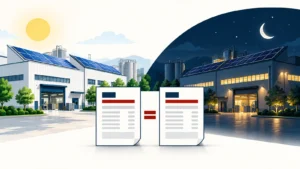
At midday, the factory roof was still sunny, but the production line had stopped due to a power outage. The factory had installed solar power, so why were the machines still shut down?
Usability Solar power in case of grid power outage. This depends on the system configuration. With conventional grid-tied solar power, the inverter stops supplying power to the plant when the grid fails. The plant can maintain partial or full operation if a backup power source is designed for the equipment that needs to run. In some configurations, the solar power can continue contributing power after the system has been disconnected from the grid. NREL — Solar power during grid outages

When the grid fails, why does the solar inverter stop supplying power?
Solar panels generate direct current (DC) electricity. An inverter converts this electricity into alternating current (AC) for the plant's use. In a typical grid-tied system, the inverter uses the grid voltage and frequency as a reference. When a grid power outage is confirmed, the inverter stops supplying AC power. There is a protection mechanism against grid power loss.anti-islandingThis helps prevent reverse power supply to a line that is experiencing a power outage. U.S. Department of Energy — Inverter and Grid Services · NREL — Solar power during grid outages
To use solar power during a power outage, the system needs to disconnect the backup power from the grid and maintain stable voltage and frequency in that section. This is an independent operating mode, often referred to as a power grid. islanding This is intentional. The specific configuration determines whether solar power is allowed to participate in power supply in this mode. U.S. Department of Energy — Grid-tied Inverter
Three solar power configurations in case of grid power outage.
| Configuration | When the power grid fails |
|---|---|
| Only conventional grid-tied solar panels. | The solar panel will stop supplying AC power. Devices without a backup power source will stop working. |
| Solar and backup generators | The generator powers circuits designed to receive backup power. Solar power can only co-supply power if the system is designed to coordinate the two sources in grid-off mode. |
| Solar and battery storage with backup modes. | The system can be grid-tied and use batteries to power a selected group of devices. Solar panels can supplement electricity when there is enough sunlight, if the design allows. |

If we have a generator, can we run solar power alongside it?
With a typical backup generator configuration, the inverter switches the selected circuits to the generator. Solar power supply needs to be considered separately. When the load drops suddenly or the sunlight changes, the control system must maintain a balance between power generation and power consumption. The contractor needs to check the compatibility between the inverter, generator, control system, and protection system. NREL — A Guide to Microgrid Design
With battery storage, will the factory be able to run continuously?
Battery-powered storage systems, often called BESS, can be installed to increase the amount of solar power available on-site or for backup purposes. For backup purposes, the owner needs to determine if the system is grid-tied, which circuits it can power, and how long the switching time is. Control equipment requiring continuous power may need a UPS if the switching time exceeds the equipment's capacity. NREL — Solar power during grid outages · Solar power combined with BESS for the factory.
Will a solar system with reverse polarity continue to operate during a grid outage?
Anti-backflow mode, commonly known as zero export, This limits the amount of solar power fed into the grid when the plant is connected to the grid. To use solar power during a grid outage, the plant still needs a system designed to decouple from the grid and supply power to selected loads.
What equipment needs to be kept on standby and for how long?
Two plants might both want two hours of standby time, but have different goals. A cold storage facility might prioritize the refrigeration unit necessary to protect goods. A manufacturing plant might only need to maintain controls and auxiliary equipment to shut down the line according to procedure. The operations team should define their goals before selecting standby capacity and amount.
For example, a group of devices using 120 kW for two hours.
Assume the group of devices needs to maintain consistent power consumption. 120 kW in 2 hours, The amount of electricity that needs to be supplied to the device is 240 kWh. This is an illustrative example assuming that the portion of electricity supplied by solar power during a grid outage is not included in the calculation.

- MCU This indicates how much power the backup source can supply simultaneously. Short-term power surges when some equipment starts up should also be considered.
- kWh This indicates the amount of electricity needed to power the equipment for the expected duration. When selecting batteries, contractors need to consider the actual usable capacity, the backup battery capacity, and power loss during supply.
The actual backup time varies depending on the amount of battery power remaining at the time of a failure, the usage of the equipment, and the amount of solar power that can be contributed. NREL — Evaluating the backup power capabilities of solar and battery systems
Four questions to finalize with the contractor before choosing an option.
- Which devices must continue running? List them by circuit or production line, including any auxiliary systems needed for the line to function.
- How long does the run need to be, and how long is the interruption acceptable? Separate the power supply needs for a few hours from the instantaneous switching needs of each device.
- When the grid fails, which power source will supply electricity to each group of devices? The contractor is requested to clearly indicate the roles of the solar panels, batteries, and generator on the schematic diagram, including scenarios for nighttime power outages or when the batteries are low on charge.
- How is the reliability of backup capabilities verified? Agree on a scenario beforehand to test for a grid outage, switch power sources, restore power to priority loads, and return to normal operation.
If the factory already has solar power or is planning to invest in it, please send the data cons. List of equipment requiring maintenance, desired backup time, and existing electrical diagram. to discuss suitable options. Contact DATA Cons